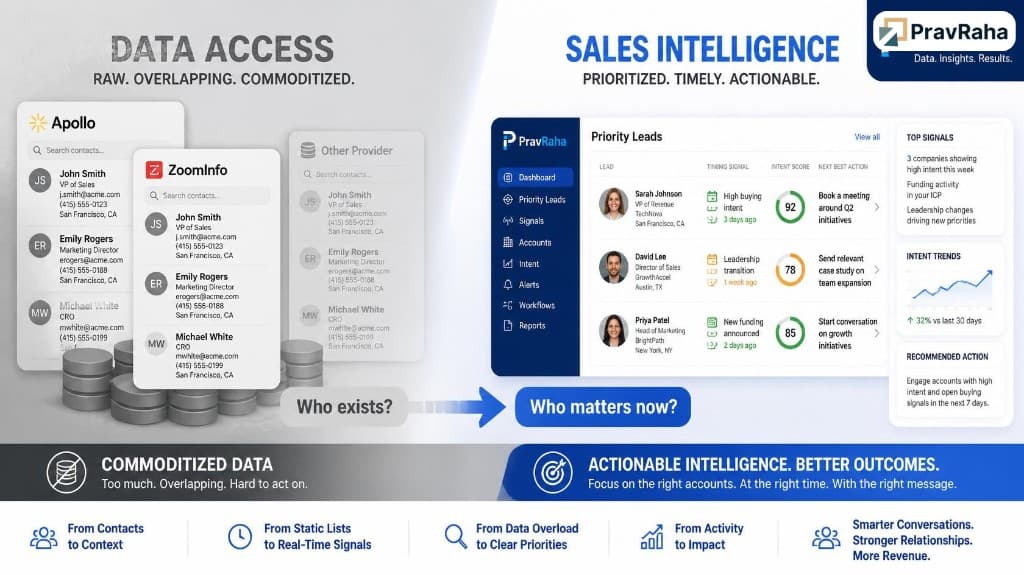
Our view is that access to contact data is no longer enough to create advantage. Large providers such as Apollo and ZoomInfo each offer very large contact and company databases, and coverage across vendors overlaps in places, so owning a database does not create the moat it once did. Where a database used to be proprietary leverage, it is now an input many teams can buy or approximate. This is our reading of the market, not a measured result.
That matters because sales teams often confuse access with edge. Not long ago, having the right contact record or direct email felt powerful. Today, many teams can reach the same person through several tools within minutes. Once that is normal, the useful question shifts from "can we find them?" to "should we contact them now, and why?" The problem becomes timing and context rather than discovery.
We think of that as a move from data to intelligence. A flat database tells you who exists. A more useful system tells you which accounts show signs of change this week, what changed in their world, and how that should shape the outreach angle. That is a different job, and it is the one we build PravRaha for. Teams that turn raw records into prioritised, timely actions give themselves a better chance, though no tool can promise a result.
When a resource becomes abundant, value moves upstream. Data becomes the raw material. Decision quality becomes the differentiator.
A framing we find useful: when a resource becomes abundant, value moves upstream. Here, the upstream layer is timing, interpretation and prioritisation. Data becomes the raw material, and decision quality becomes the difference between teams. If you already pay for a data provider, keep it. The open question is what you do with the records once you have them.
A contact database is sales intelligence: who exists, who fits, and how to reach them. The advantage now sits in deciding which of those records to work this week.