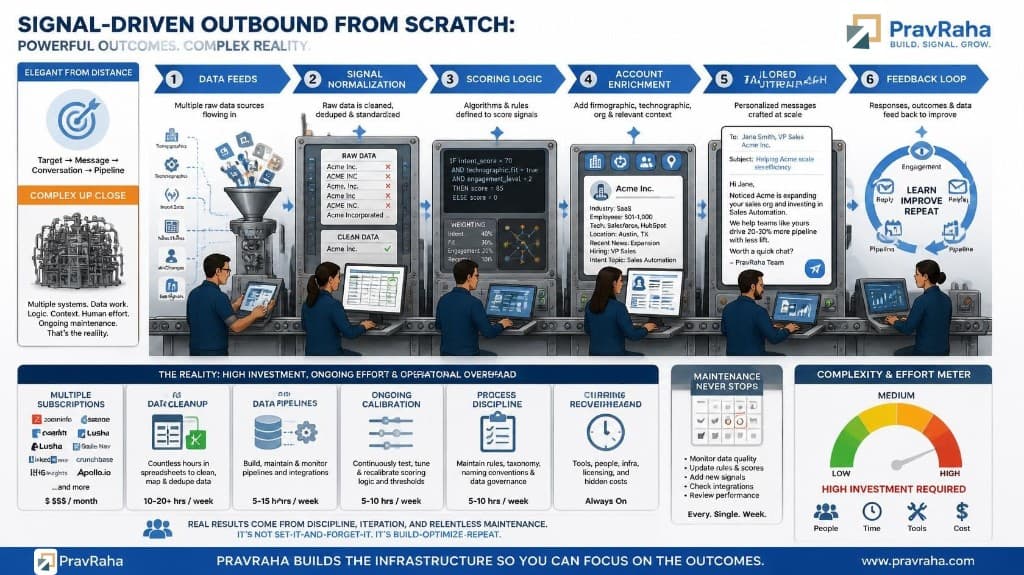
You can build signal-driven outbound yourself with generic tools. The steps below are the manual version of what PravRaha automates, and we would rather show you than have you guess. Here is the process, then where the effort goes.
Step one: define the account list. Write your ideal customer profile in plain terms: industry, company size, region and the team that buys. Put a few hundred matching accounts in a spreadsheet or your CRM, with a column for the company, the domain and an owner. A smaller, sharper list beats a big vague one.
Step two: pick three to five signals and a source for each. For hiring, watch careers pages or job boards for roles in the function you sell to. For funding, set news alerts on the company name. For leadership change, use alerts and LinkedIn to catch new executives in your buyer's function. For technology change, read job descriptions and public engineering pages for tools you replace or integrate with. For expansion, watch for new offices, products or regions. Log each event with a date, a link and one line on why it might matter.
Many systems look elegant from a distance. Up close, they need process discipline, an owner and regular calibration.
Step three: score the accounts. Give each signal a point, and add weight when two signals point the same way, for example a hiring push and a new executive in the same function. Set a threshold and review the list weekly. The score is a priority order for human attention and does not predict a purchase date.
Step four: find the people and write. For each account over the threshold, name the likely economic buyer, technical champion and coach. Write a first message of two or three sentences that names the event and connects it to a problem you solve. Send it from your own mailbox with a clear way to opt out, log it in the CRM and read the replies yourself.
Step five: maintain it. Alerts get noisy, sources change, lists go stale and scores drift. Someone has to own the cleanup every week and retire signals that never lead to a conversation. This part is easy to underestimate, and hand-built systems can decay without an owner.
PravRaha saves effort in the monitoring. It watches for signals on your accounts, attaches events to the right account, finds the buying committee, drafts outreach grounded on the trigger and syncs with Salesforce or HubSpot. Much of the weekly monitoring work moves off your calendar. It does not pick your ideal customer profile, promise meetings, or replace your judgment about what to send. If you have a short list and spare operations time, build it first. If you know the maintenance is the step you will skip, that is the case for a platform, and there is a 7-day free trial with no credit card to test it.