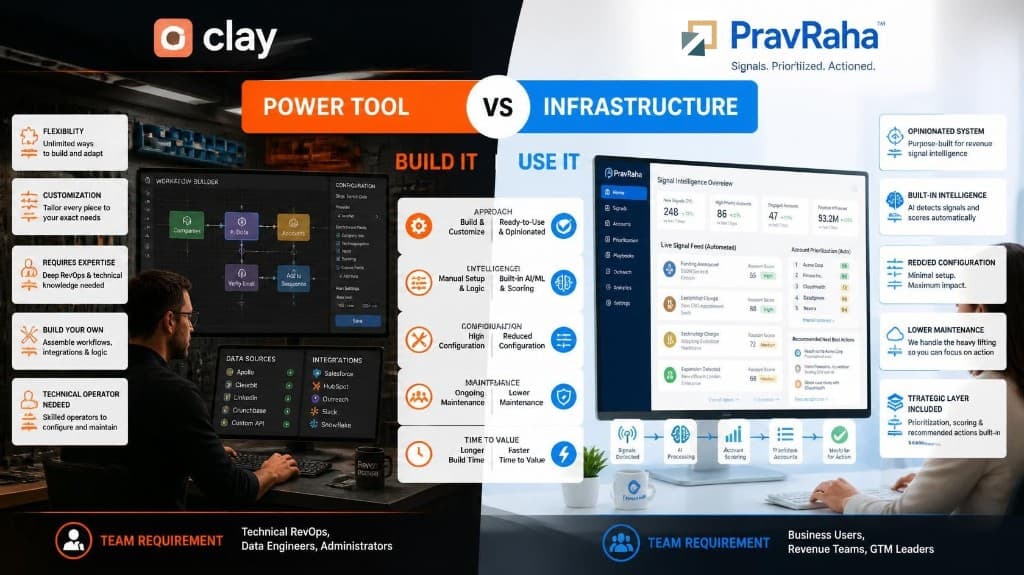
The useful way to compare Clay and PravRaha is to stop pretending they do the same job. Clay describes itself as infrastructure to get data, run agentic workflows and launch go-to-market plays (per its website as of October 2026). It is a flexible workflow and enrichment platform for capable operators. PravRaha is a pre-built system that takes on more of the setup and maintenance. The right choice depends on your team's capability and on who you want to own the workflow.
Clay can be very effective in the hands of a technically strong RevOps or outbound leader. It offers flexibility, customisation and the ability to stitch together workflows creatively. That flexibility also assumes the team knows what to build, how to score accounts, how to structure the logic and how to maintain it over time. Without that expertise, any builder tool can turn into ad hoc complexity. If you have that person and enjoy the work, Clay is a strong choice.
PravRaha solves a different problem. It is not a toolkit for building workflows. It watches for hiring, funding, leadership change, tech-stack change and expansion signals, prioritises accounts against your ICP, maps the buying committee, and drafts outreach grounded on the trigger. Your team reviews and approves each message before it is sent from your own connected mailbox. That suits teams who want an opinionated system with less to configure and maintain. It does not offer Clay's flexibility, and for an unusual ICP or data source, Clay may fit better. Some teams use both.
Clay is a flexible workflow tool for capable operators. PravRaha is a pre-built system that takes on more of the setup and maintenance.
Enrichment workflows still sit on sales intelligence: the contacts, firmographics, and technographics underneath the table. The operating question is what you do after the row is filled.