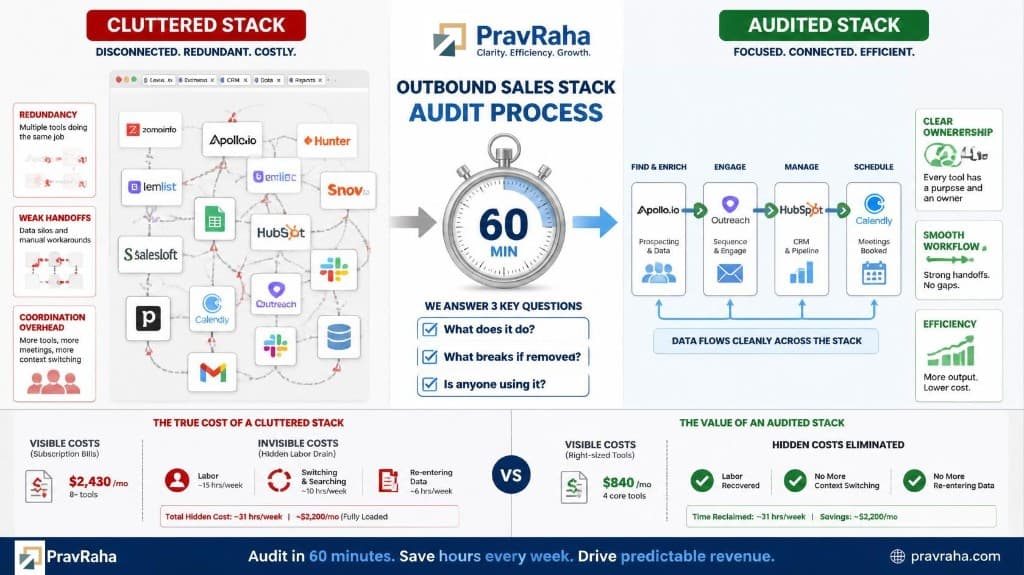
Most outbound stacks grow without a plan. New tools are added to solve an immediate problem, old tools are rarely removed, and eventually the team works inside a patchwork that nobody fully owns. That slow build-up creates friction and hides what is actually driving results. A short audit is a practical way to see it clearly.
Here is the structure we suggest for the 60 minutes. First, list every tool that touches the outbound motion. Then ask three questions of each one: what does it do, what breaks if we remove it, and is anyone actively using it? That exposes redundancy, weak ownership and unused subscriptions quickly, and gives you clear next steps.
Handoff mapping is the step teams skip. Most stacks do not fail because one tool is bad. They fail because information moves badly between tools. Data gets duplicated, context gets dropped, and accountability blurs each time the workflow crosses from one platform to another. The cost shows up as weaker targeting, slower execution and messy reporting.
The visible cost is the subscription bill. The invisible cost is labor: switching tabs, reformatting lists, re-entering data and fixing sync errors.
There is also a financial point. The visible cost is the subscription bill. The invisible cost is labor: switching tabs, reformatting lists, re-entering data, fixing sync errors and retraining people whenever the process changes. For some teams that coordination overhead can cost more than the software itself, and an audit can show you whether yours does. Pruning unused tools and clarifying ownership are usually the first wins. If you want the longer version of this argument, read our post on the coordination tax.