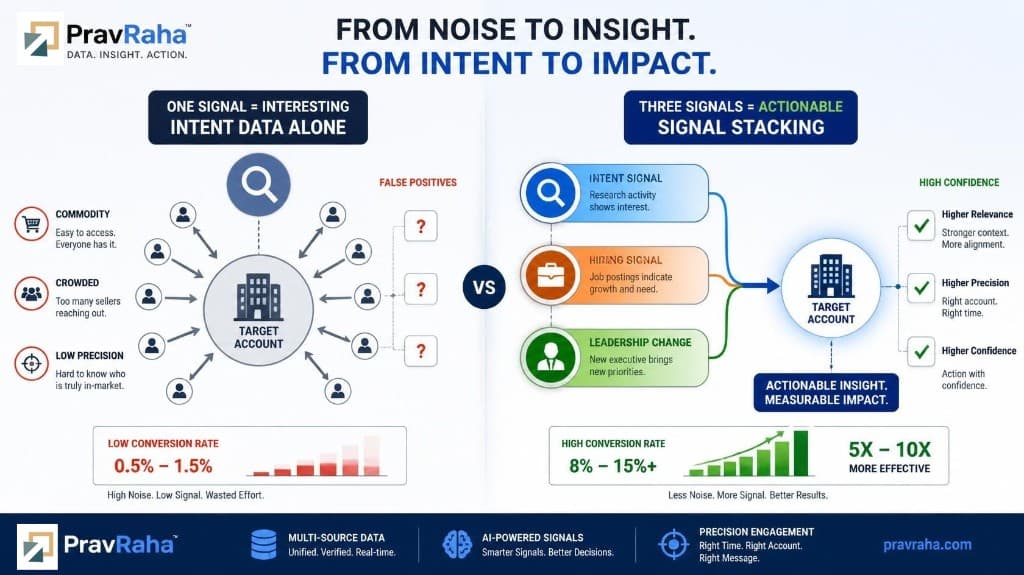
We think intent data is no longer a durable edge by itself. Once many vendors buy access to the same behavioral signals, the result is predictable: the same "in-market" accounts get targeted by many teams at once, and what felt like privileged insight starts producing noise. Overusing intent without context leads to crowded outreach and lower response. This is our view from watching how outbound works, not a measured study.
That is a useful correction. Intent data still has value, but not as a standalone trigger. A company researching a category may be close to purchase, far from it, casually exploring, or doing internal benchmarking. Without context, the signal tells you that something happened, but not what it means. Acting on intent alone tends to produce false positives and wasted outreach.
The approach we prefer is signal stacking. One signal can be interesting. Three related signals can be actionable. If a company is researching your category, hiring in a relevant function and has just added a new executive, that combination tells a stronger story than a single intent score. Stacking should reduce noise, though how much depends on your market.
One signal can be interesting. Three related signals can be actionable.
It also changes how you write. You stop leading with vendor jargon and start with buying context: what changed at the account and why it matters to the person you are writing to. Teams that pair intent with corroborating signals, such as hiring, funding, leadership change and tech-stack change, and then add human interpretation, are likely to get more from the same inputs.
A topic surge is not sales intelligence. That layer tells you who exists and who fits. Stacked signals are what say whether they are moving.