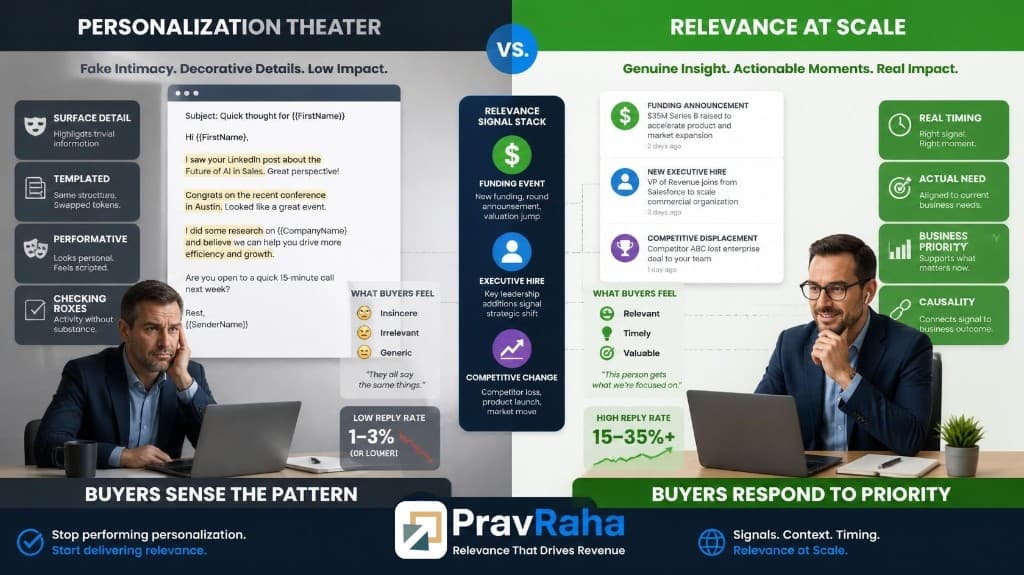
Mass-personalized outreach often fails to persuade, because buyers spot the pattern quickly. A line about a LinkedIn post, a press release or a conference talk looks specific but still reads as templated. The buyer can tell the detail was added to tick a box and does nothing for the value of the message. We think that is the lie we tell ourselves about scale.
Personalization and relevance are different things. Personalization stops at surface detail; relevance follows timing and need. A message becomes relevant when it ties to a real change in the prospect's world, and proving the sender spent five minutes on their profile does not do that. Relevance connects to a priority. Surface detail usually does not.
Relevant moments are specific. Funding shifts internal pressure. A new executive often reopens how decisions get made. Hiring in one function shows where money is going, and a stack change can alter what a team needs next. Each is a reason a conversation might make sense now rather than later.
Personalization tends to stop at surface detail. Relevance starts from timing and need.
Relevance also has to account for the whole buying committee. Many B2B purchases involve more than one person: an economic buyer who owns the budget, a technical champion who will live with the tool, and someone who can coach you through the organization. The same trigger matters to each of them differently. A message that explains the event in terms of the reader's own role is more useful than one generic note sent to everyone.
At PravRaha, the business event is attached to the account, the buying committee is identified and the draft is built around the trigger, so the reason for the message exists before a word is written. We make no promise about response rates, and no system can fake intimacy at scale. What it can do is help you contact fewer accounts for better reasons, which protects your credibility.