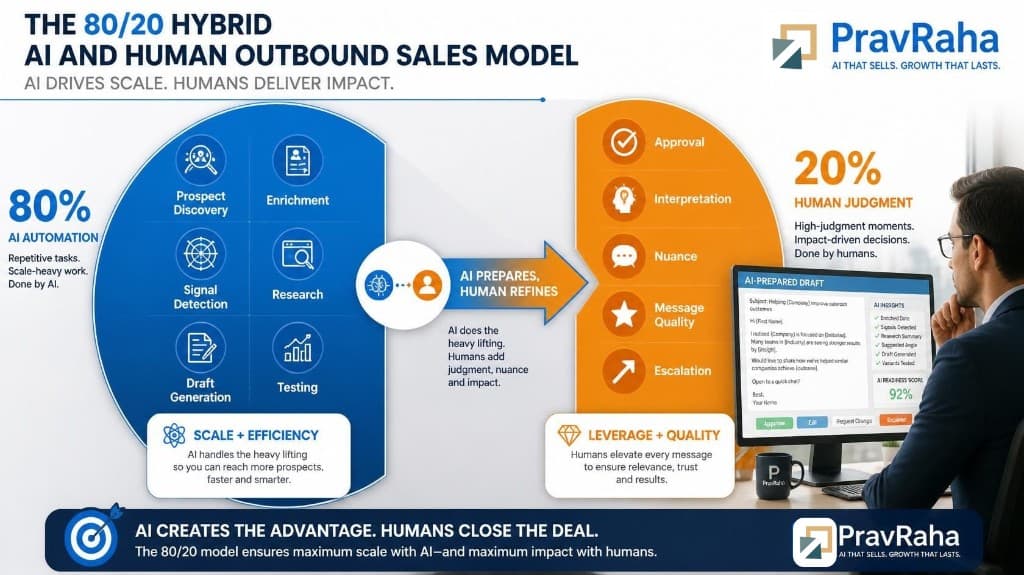
We split outbound roughly 80/20. AI carries about 80 percent of the workload: the repetitive, high-volume, low-judgment work. People own the other 20 percent, where nuance, instinct and message quality decide the outcome. This is our rule of thumb, not a measured result: the numbers show roughly where each side adds the most value.
Both extremes fail in predictable ways. Fully automated outbound gives you scale without relevance: more messages, and less reason for anyone to answer them. Fully manual outbound gives you quality without durability: a handful of excellent emails, then a rep who runs out of hours. A hybrid design lets each side do what it is good at.
On the AI side, the work is account discovery, enrichment, signal detection, research collation, sequence support, testing and first drafts. That work rewards volume and consistency more than emotional intelligence, and software does it without getting tired. On the human side, the work is review, interpretation, escalation and the many small calls that decide whether outreach feels thoughtful or careless: whether a trigger is worth acting on, whether to pause after a reply, and whether a draft sounds like us.
The point of the split is not to remove people. It is to point them at the 20 percent that decides the outcome.
The 80 percent saves labor, but it also makes the 20 percent better. A rep who reviews a draft built on a real business event is not starting from a blank page. They are editing a strong first version, which raises speed and quality together. That is how the split compounds instead of just dividing the work.
This is also how we build PravRaha. The platform finds the signal, attaches it to the account, identifies the buying committee and drafts outreach grounded on the trigger. Your team decides what goes out, from your own mailbox. We do not think software should run outbound alone, and we do not promise a guaranteed outcome. Software should absorb the work people should not be doing before anything else.