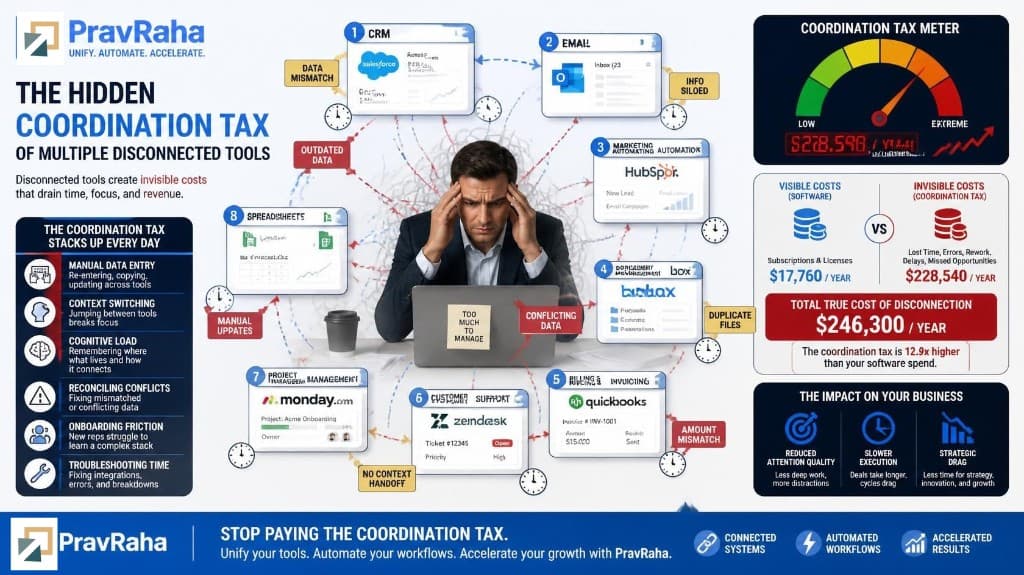
In our experience, many revenue teams feel this problem and few measure it. We call it the coordination tax: the cost of making disconnected tools work together. It is paid in copying data by hand, reconciling numbers that disagree, onboarding people into fragmented systems and troubleshooting workflows that should have been simple.
Subscriptions show up on an invoice; the tax shows up in handoffs. Picture an illustrative stack of eight tools: list building, enrichment, intent data, sequencing, CRM, calendar, call tool and analytics. Eight is an example, not a survey figure. Each time work crosses from one tool to the next, someone or something has to carry the data across, and something can get lost on the way: a field, a note, the reason the account was chosen in the first place.
For example, a rep re-enters the same account details in three places for each of ten new accounts a week. That is thirty entries, and each one is a chance to mistype, skip a field or fall behind. This is a made-up illustration of the mechanism, not a finding. Across a team and a quarter, though, it shows why the cost never sits on one line of a budget.
Stack complexity has a cost, and it comes out of output, judgment and speed.
Context is the larger loss. The tool that detected a trigger is often not the tool that sends the message, and the person writing the email may never see why the account was prioritized. Every tool switch is also a context switch, and each one raises the chance of weaker research, a missed detail or a slower follow-up. A team that spends its attention managing the system has less left for the work that creates pipeline.
We will not give you a number for your team, because it depends on your stack and how it is wired. The cost is real, though, and it lands on your team's time and attention. The practical levers are pruning and ownership. List every tool in the outbound motion and write down what it does, what breaks if you remove it and who actually uses it. Then map where information changes hands. Our audit post, "How to audit your outbound stack in 60 minutes", walks through that exercise.
This is also why we built PravRaha as one flow from signal to account, buying committee, drafted message and send. It will not remove every tool you own, and it sits alongside your CRM instead of replacing it. The aim is fewer handoffs for the same work, which leaves your team more time for the decisions that need a person.